Al llegar a casa después de un largo viaje, con incontables imágenes en mis retinas y algunas en la tarjeta de memoria de mi cámara, sentía la necesidad de escribir algo de ella, aunque más bien debería decir algo a partir de ellas. Ese algo debía mostrar qué me impulsó a escoger esa imagen y no otra. Tal y como me ocurrió con la siguiente fotografía.
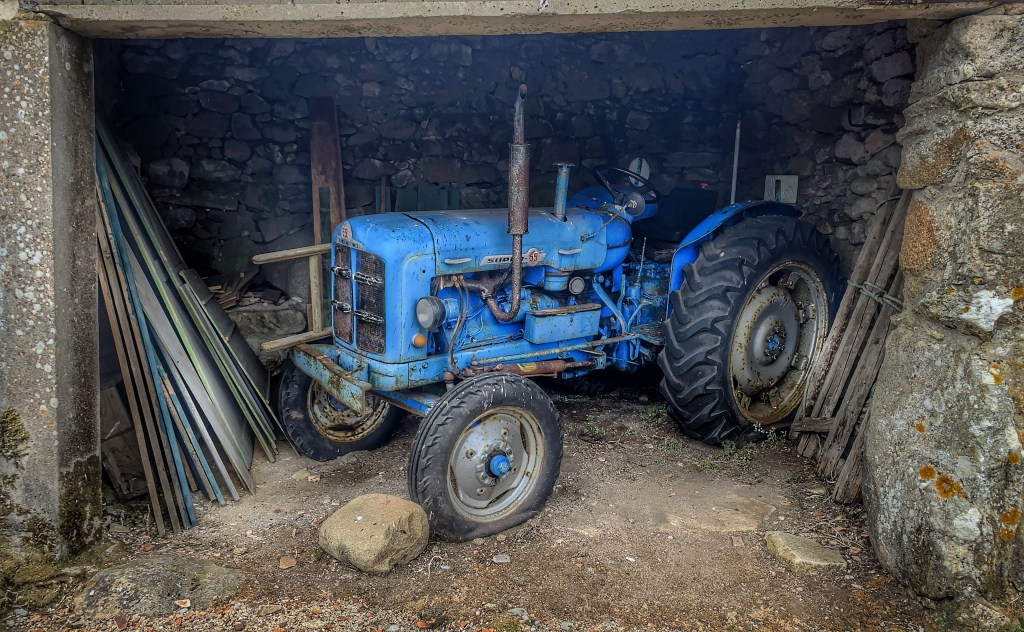
Lo importante no era que capturara esta imagen en una aldea abandonada de la isla de Sálvora, un pequeño pedazo de tierra en el océano Atlántico, a tres kilómetros de la costa, en la bocana de la ría de Arousa. Ni tampoco que esta isla fuese conocida porque en ella, en el año 1921 naufragó un navío debido a una tormenta y donde murieron más de doscientas personas. Tampoco que durante aquella desgracia tres mujeres, sencillas, duras y valientes, desafiaran las olas enormes en la noche furiosa para hacerse a la mar en un bote y lograr rescatar a más de una docena de aquellos a los que despertó una pesadilla.
No, la localización fue, en cierto modo, accidental, si es que puede ser. De hecho, el tractor es muy posterior a los hechos del naufragio, pues este modelo comenzó a fabricarse a finales de los años cincuenta. No, debió de ser otra cosa; debió de ser cosa de la visión.
Estaba allí, como si durmiera un largo sueño. Un sueño de esforzadas labores en el campo, ayudando a extraer de él el fruto del tiempo y del agua. Rugiría con sus cabellos de potencia y expulsaría por su alto escape todo su orgullo. Era un Súper y no debía de ser poca cosa.
Ahora dormía y, aun así, una pesada piedra contenía su ruega izquierda delantera, no fuera a querer salir de nuevo a arar la tierra y dibujar semilleros de esperanza.
The old tractor
Arriving home after a long journey, with countless images in my retinas and some on my camera’s memory card, I felt the need to write something down, although I should rather say something from them. That something should show what prompted me to choose that image and not another. Just as I did with the next picture.
The important thing was not that he captured this image in an abandoned village on the island of Sálvora, a small piece of land in the Atlantic Ocean, three kilometres from the coast, at the mouth of the Ria de Arousa. Nor was this island known because a ship was shipwrecked there in 1921 due to a storm and more than two hundred people died. Nor was it known that during that misfortune three women, simple, tough and brave, defied the enormous waves in the raging night to take to sea in a boat and manage to rescue more than a dozen of those who were awakened by a nightmare.
No, the location was somewhat accidental, if that’s possible. In fact, the tractor comes well after the events of the shipwreck, as this model was first produced in the late 1950s. No, it must have been something else; it must have been a matter of vision.
He was there, as if sleeping a long sleep. A dream of hard work in the field, helping to extract from it the fruit of time and water. He would roar with his hair of power and expel by his high escape all his pride. He was a Super and must have been no small thing.
Now he slept, and yet a heavy stone contained his front left prayer that he would not go out again to plough the earth and draw seedlings of hope.
His eyes were looking straight ahead and I felt that he saw me looking at him, measuring his years, assessing his scars, noticing his tiredness. I wanted to take him with me and this is the way I know best.
 Medusa´s gaze